


“Guadeloupe is not a place to visit at random, it’s a place to plan ahead and let yourself be surprised.”
Let’s be honest: a successful trip to Guadeloupe doesn’t rely on luck, but on a few good logistical choices made long before you set foot at Pôle Caraïbes airport. Between managing the climate, the headache of car rental and organizing an itinerary that makes sense, it’s easy to feel overwhelmed.
People come here for the diversity: the volcano, the rainforests, the white sandy beaches and, of course, the seabed. But to enjoy all this without spending your days in traffic jams or waiting for a downpour to pass, you need a plan. At Les Nautilus, we see travelers come and go all year round in Malendure. Here are our practical tips for preparing your stay, far from the clichés of brochures, but as close as possible to the reality on the ground.
1. Choosing your period: When to leave without making a mistake?
The “dry season” (January to May) is the safest for sunshine. The “wet season” (June to November) offers lower rates, but requires flexibility in the face of tropical squalls.
The climate is the first factor in the success of your trip to Guadeloupe.
- Lent (dry season): This is the ideal time for hiking and sailing. Underwater visibility is often better, which is crucial if you plan to explore the Cousteau Reserve.
- Hivernage (wet season): Nature is greener, prices drop, but you have to accept that your program may be altered by a heavy downpour from time to time.
Local tip: Whatever the season, the sea remains warm (26 to 29°C). While the weather forecast calls for rain on Basse-Terre, it’s often sunny on Grande-Terre. That’s the advantage of the butterfly island.
2. Logistics: Car and accommodation, the winning duo
Rent your car several months in advance (it’s the sinews of war). For accommodation, split your stay in two: Basse-Terre for the green, Grande-Terre for the blue.
Without a car, your trip to Guadeloupe will be very limited. Public transport is haphazard and doesn’t serve the most beautiful trailheads or isolated beaches.
- The car: Choose a model with a decent engine if you plan to climb Basse-Terre. The roads are steep!
- Accommodation: Don’t make the mistake of staying in one place for 10 days.
- 5 days in Basse-Terre (Bouillante/Deshaies side): To get as close as possible to the Cousteau Reserve, the volcano and the waterfalls.
- 5 days in Grande-Terre (Sainte-Anne/Saint-François side): For lagoons and markets.
3. Planning your activities: The example of the Cousteau Reserve
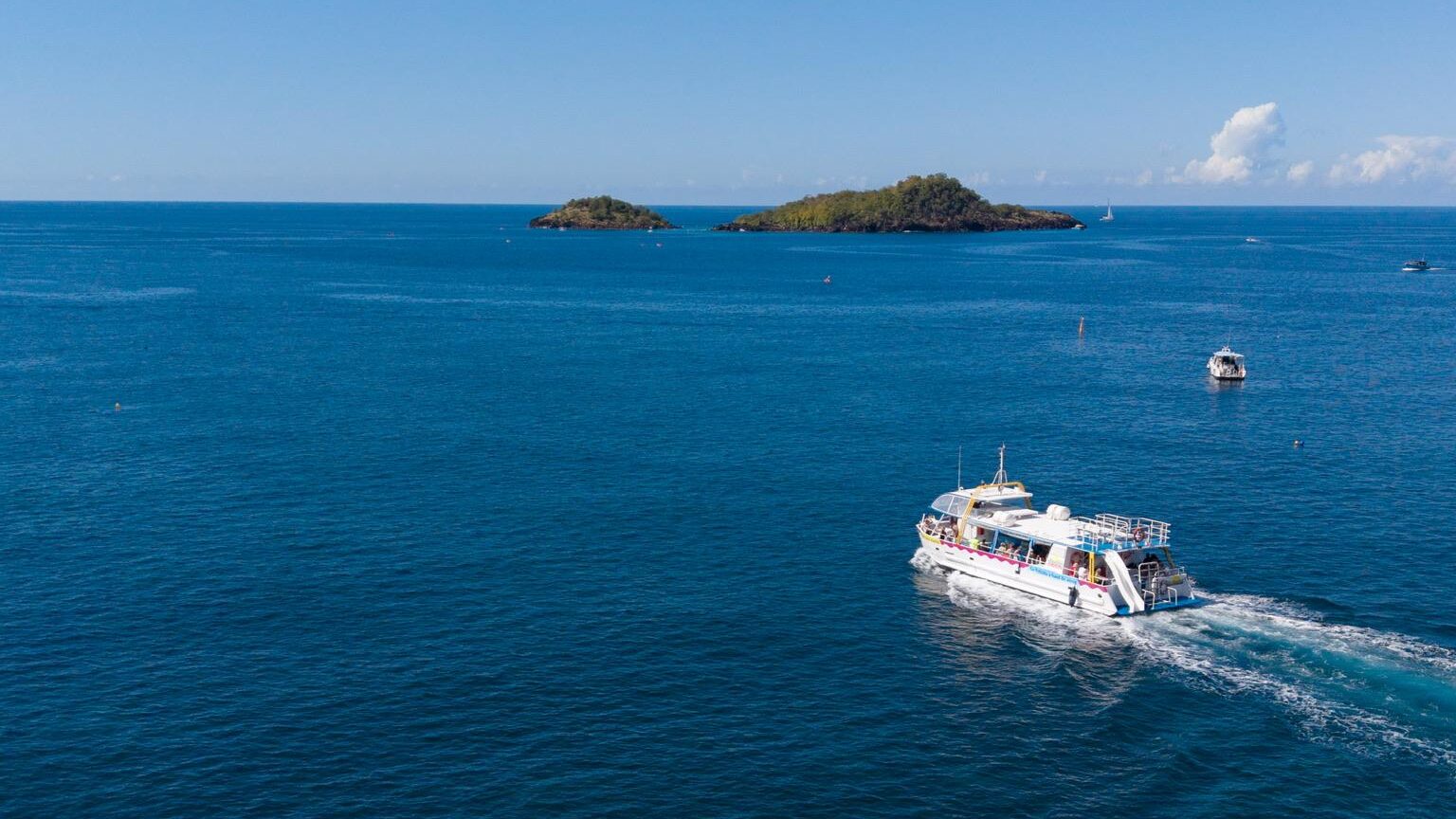
Don’t saturate your days. Plan one “big” activity per day. A visit to the Cousteau Reserve is a must, and a glass-bottomed boat is the easiest way to see the essentials without stress.
The Cousteau Reserve, opposite Malendure beach, is the island’s marine heart. It’s here that turtles and coral gardens are most easily seen. But how do you get there?
| Option | For whom? | Concrete benefits |
| Glass-bottom boat (Nautilus) | The whole world | No need to swim, panoramic view, wildlife commentary. |
| Kayak rental | The sportiest | Total freedom, but watch out for the wind and currents on the way back. |
| Diving experience | The curious (ages 8 and up) | Feels weightless, but requires more time and energy. |
For many, the Nautilus experience is the most balanced. It’s a 1h30 outing that combines sun-sheltered observation with a swim break for those who want to get in the water. It’s efficient, professional, and lets you see species like Blennies without having to master scuba diving.
4. Safety: Listen to the sea and the locals
Safety is not an option. A red flag or a captain who cancels an outing is a rule of life here. Respect the rules to make your vacation a pleasure.
When planning your trip to Guadeloupe, you’ll read that the sea is calm on the Caribbean side. It’s true, but nature reigns supreme.
- The captain’s role: On a boat like Nautilus, the captain is responsible for everyone on board. If he feels that the swell is too high for safe boarding (especially for senior citizens or people with reduced mobility), his decision is final. It’s never to annoy you, it’s to protect you.
- Hiking: Don’t set off into the forest without checking the weather. Rivers can rise in minutes after a rainstorm in the mountains.
5. Using digital tools: Guadeloupe in 11K
Use Google Street View to find your way around. The 11K mapping project, funded by Les Nautilus, lets you see beach accesses and trails before you even arrive.
To prepare your itinerary, take advantage of the technological innovation available in 2026. Guadeloupe has been entirely digitized in Ultra-High Definition (11K) for Google Maps. It’s a major project supported by Les Nautilus to raise the profile of the region.
Before you leave, take a virtual “walk” along Malendure beach or check the width of a mountain road. It’s the perfect tool for removing any logistical doubts.
FAQ : Planning your trip to Guadeloupe
Do you have to speak Creole to get by?
Not at all, French is the official language. But learning a few words like “Bonjour”(Bonjou) or “Merci”(Mèsi) will put a smile on your face.
What’s your meal budget?
Guadeloupe offers everything from “bokit” (local sandwich) on the beach to gourmet restaurants. Plan on an average budget of €30 per day per person if you alternate home-cooked meals and outings.
How to avoid mosquitoes?
This is the big topic! Take along repellents adapted to tropical zones, wear long clothes in the evening and check that your accommodation is equipped with mosquito nets.
Conclusion: Stay flexible and take advantage
Preparing your trip to Guadeloupe means accepting that not everything will go exactly to plan. A traffic jam on the main road, a tropical squall that postpones a sea outing… stay flexible.
The magic of the island happens when you take the time to chat with the locals and accept the “Antilles” rhythm. The Cousteau Reserve will be there, the turtles too, and our team will be delighted to welcome you and show you the best we have to offer beneath the surface.